

Research report · with the CIPD
CIPD HR Pulse Report 2026: Inside the people profession
What 883 UK people professionals told the CIPD about their priorities, the capability to deliver them, AI, careers and the pressures on the profession. Supported by Talking Talent.
What’s inside
The CIPD’s annual snapshot of the people profession, supported by Talking Talent.
Based on a YouGov survey of 883 UK people professionals between May and June 2026, weighted to represent the profession, the report benchmarks what people teams are prioritising, how the wider business sees them, how they’re adopting AI, how careers in the profession are developing and the pressures people professionals carry.
Inside the report
- The top priorities for people teams, and the gap between demand and specialist capability
- The internal reputation and strategic maturity of people functions
- How people teams are adopting and integrating AI
- Career progression and personal development in the profession
- HR pressures and employer support
- Forewords from the CIPD and from Mary-Clare Race, Talking Talent’s CEO, with reflective points for people teams
Key findings
What matters to people teams right now
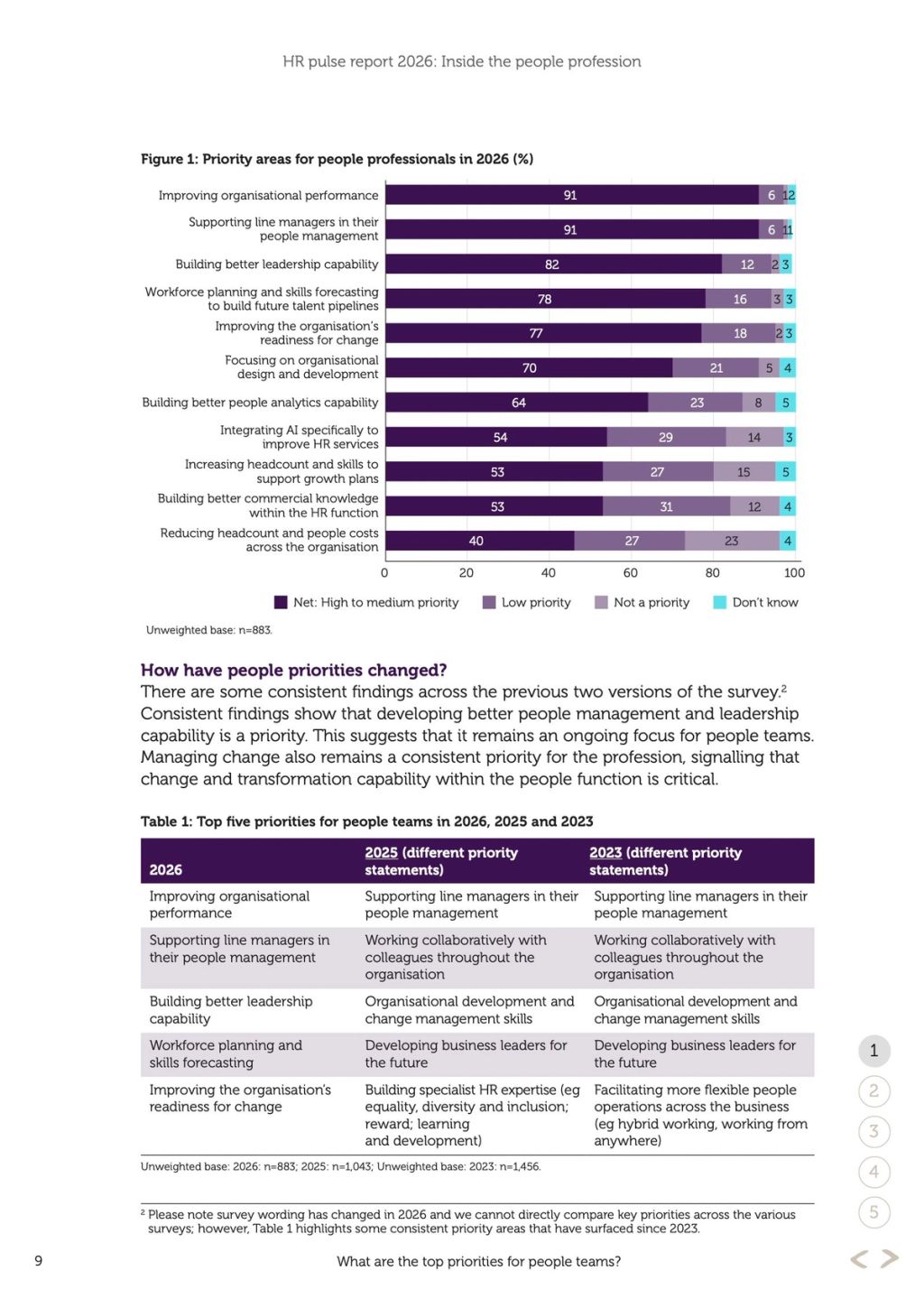
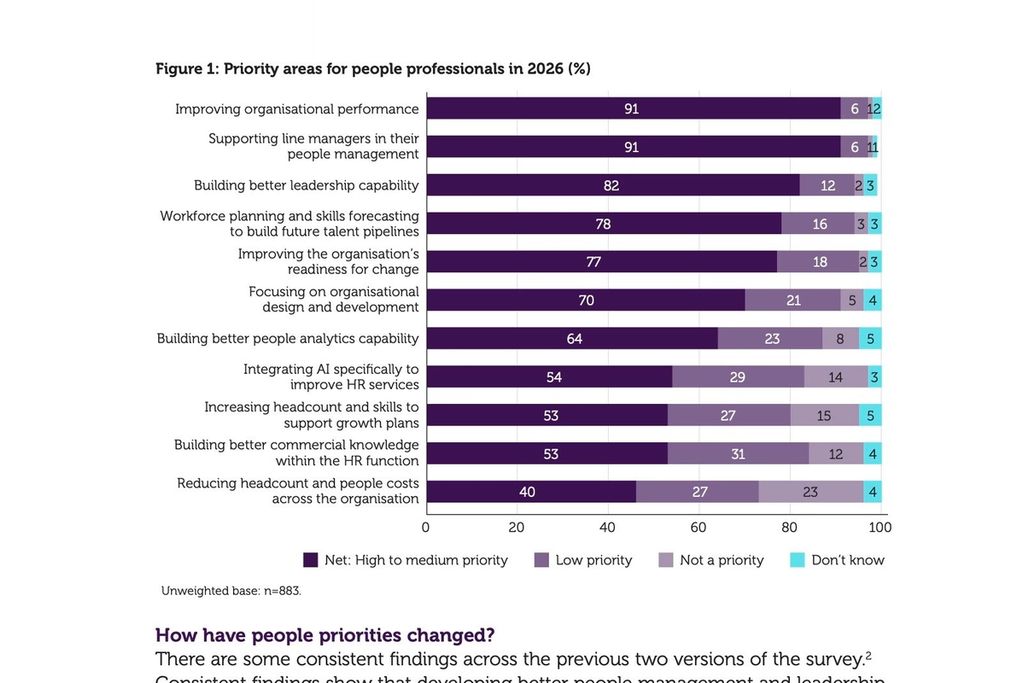
The share of people professionals who rate each area a high or medium priority for their people team in 2026.
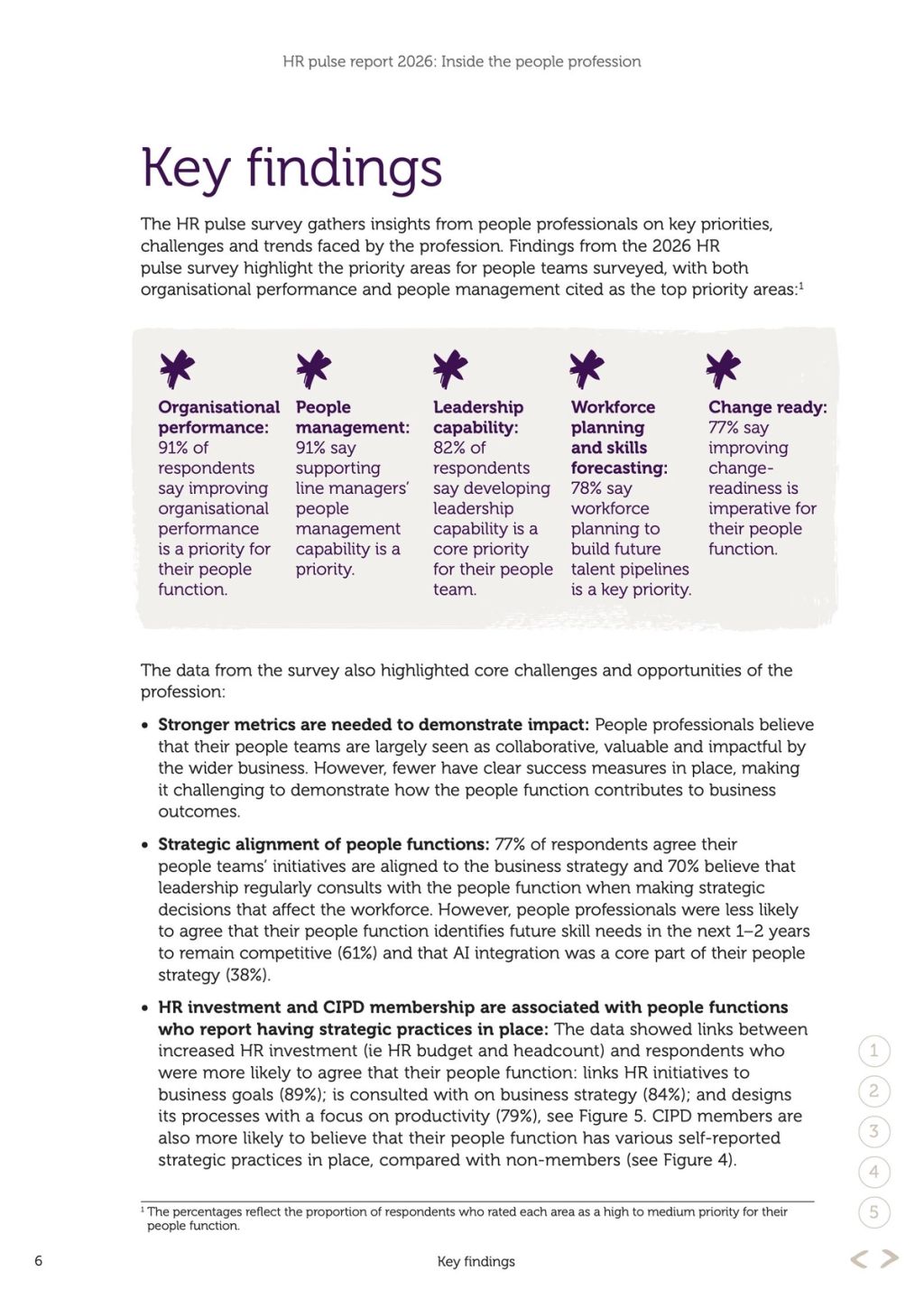
91%
Organisational performance is a top priority
People teams are focused on improving organisational performance. That means connecting people strategy with the outcomes the business needs to achieve.
91%
Line managers need support
People professionals recognise the importance of strengthening line managers’ people management capability, so they can handle the day-to-day challenges of leading and supporting their teams.
82%
Leadership capability is a core focus
Developing leadership capability is a core priority: leaders need the skills to support their people and help the organisation perform.
78%
Workforce planning is key to future talent
People teams see workforce planning and skills forecasting as important to building future talent pipelines and preparing for changing capability needs.
77%
Change readiness is imperative
People teams recognise the need to improve organisational readiness for change, so the organisation can respond to shifting priorities and what comes next.
The challenge
Priorities are clear. Building the capability is the challenge.
The research shows that people teams understand their organisations’ priorities. Improving organisational performance and supporting line managers are top priorities, while leadership development, workforce planning and change readiness are also high on the agenda.
But recognising a priority and having the capability to deliver it are two different things. The report highlights where people teams may need more support, from developing specialist skills and making better use of AI to demonstrating the impact of their work.
There’s also a wider question about how the profession itself is supported to keep developing. People professionals are dealing with high emotional demands and competing expectations, while the skills needed to shape the future of work keep evolving.
For organisations, the opportunity is to look beyond the priorities themselves and consider what will help their people teams turn good intentions into meaningful progress.
Beyond the priorities
- say AI integration is a core part of their people strategy
- 38%
- Source: CIPD HR pulse report 2026 (883 UK people professionals)
- have had no training to apply AI in their role
- 75%
- Source: CIPD HR pulse report 2026 (883 UK people professionals)
- say their people function identifies the skills it will need in the next one to two years
- 61%
- Source: CIPD HR pulse report 2026 (883 UK people professionals)
- frequently feel conflicted in their role; 72% face high emotional demands and 71% cognitive overload
- 76%
- Source: CIPD HR pulse report 2026 (883 UK people professionals)
Line managers are where strategy meets the everyday experience of work. They’re the ones who explain a change and notice when someone on their team is struggling, so it makes sense that nine in ten people teams count supporting them as a priority.
Five chapters
What the report covers
Each chapter opens with a headline finding and closes with reflective points and CIPD resources for people teams.
01
The top priorities for people teams
Organisational performance and line managers’ people management capability are joint top priorities. Workforce planning ranks high too, yet few hold specialist skills in it.
02
Internal reputation and strategic maturity
People teams are widely seen as collaborative, valuable and impactful, but fewer have clear success measures to prove their contribution.
03
Adopting and integrating AI
Three in four people professionals have had no training to apply AI in their role, and 22% have never used AI tools at work.
04
Career progression and development
Junior professionals are the least confident about developing their expertise (54%, against 88% of senior people professionals).
05
HR pressures and employer support
Between 71% and 76% frequently feel conflicted, carry high emotional demands or experience cognitive overload in their role.
Who it’s for
Is this report for you?
Read it if
Read it if you’re asking
- Where should our people team focus in 2027?
- How does our function compare with the rest of the profession?
- Are we building the capability behind our priorities, or just naming them?
- How do we show the business what the people function contributes?
Skip it if
It may be less relevant if
- You need data from outside the UK: the sample is UK people professionals
- You’re looking for a policy template or a compliance checklist
Planning for 2027
Turn today’s priorities into tomorrow’s capability
The findings are a chance to look beyond what’s already on the agenda and consider what will help people teams deliver. For organisations planning ahead to 2027, three areas stand out.
Build capability around the priorities
Having leadership development, workforce planning or change readiness on the agenda is a starting point. The next step is knowing whether people teams have the skills, support and confidence to make progress, and where investment would make the biggest difference.
Prepare for the skills you’ll need next
Work is changing, and the capabilities organisations need will change with it. People teams can anticipate future skills needs, build confidence with AI and help leaders and managers adapt as work changes.
Make the impact visible
People strategy has more influence when its contribution is understood. Clear measures connect the work to business priorities, show where progress is happening and reveal where a different approach or more support is needed.
Why Talking Talent?
Coaching-led development from specialists in people, progression and workplace change
We’re a global coaching consultancy for the moments that shape careers, leadership and working lives, and we help organisations turn insight about their people into action.
Human
We meet people where they are, with coaching that creates space for honest reflection and useful progress.
Practical
Every conversation is designed to help turn insight into action.
Evidence-informed
Our work is shaped by behavioural science, coaching practice and years of supporting talent across global organisations.
Inclusive
People experience work differently, and progression often needs both personal support and awareness of the wider system.
The CIPD HR Pulse Report 2026: questions and answers
What is the CIPD HR Pulse Report 2026?
It’s the CIPD’s check-in with the UK people profession, supported by Talking Talent. This edition, Inside the people profession, asks 883 HR and people professionals what they’re prioritising, how the business sees them, how they’re using AI, how their careers are going and what the job is taking out of them.
What’s the main takeaway?
People teams know what matters; the harder part is having the capability to deliver it. Nine in ten put organisational performance and line managers’ people management capability high on their list, but many lack the specialist skills, AI training or clear success measures to make progress on them.
Who should read it?
HR directors, people leaders and practitioners who want to see how their team compares with the rest of the UK profession, plan their priorities for 2027 or make the case for investing in their own team’s capability. The data is from the UK, so it’s most useful for UK teams and UK operations.
How was the research done?
YouGov and the CIPD’s research panel surveyed 883 UK people professionals online between 1 May and 3 June 2026. The results are weighted to represent the profession by age, gender, sector and organisation size within sector, so they reflect the profession as a whole rather than one corner of it.
What does the report say about AI in HR?
Most people teams are still near the start. Only 38% say AI integration is a core part of their people strategy, three in four have had no training to apply AI in their role and one in five (22%) have never used AI tools at work. The gap is in skills and confidence more than in tools.
Why are so many HR professionals feeling stretched?
Because people teams carry a lot for everyone else. 76% frequently feel conflicted in their role, 72% face high emotional demands and 71% experience cognitive overload. Seven in ten feel their employer supports their wellbeing, but only six in ten feel supported with the pressures particular to HR.
What should our people team do with the findings?
Use them as a mirror. Check whether your team has the skills, support and confidence behind each priority, plan for the skills you’ll need next and agree how you’ll show the impact of people work. Each chapter ends with reflective points that make a good starting point for a team conversation.
Is the report free?
Yes. Fill in the short form and the PDF is ready to download straight away. We ask a few questions so anything we send afterwards is relevant to you, and we’ll only email you about our insights if you tick the box.
How is Talking Talent involved?
We supported the CIPD in producing the report, and our CEO, Mary-Clare Race, wrote one of its two forewords. Talking Talent is a global coaching consultancy that helps organisations develop leaders at every level and equip their line managers: the capabilities the report puts at the top of HR agendas.
Research report
CIPD HR Pulse Report 2026: Inside the people profession
What 883 UK people professionals told the CIPD about their priorities, the capability to deliver them, AI, careers and the pressures on the profession. Supported by Talking Talent.
Get the research reportRelated reading
Coaching in the Workplace: Choosing the Format That Changes Behaviour
The question is not which coaching format is best. It is what behaviour you are trying to change, and which format can carry that weight.
Leading Has Changed. Has Leadership Development?
Explore essential leadership skills that can enhance your effectiveness and influence within any organisation.
Why Leadership Feels Heavier Than It Did Five Years Ago
Leadership has never been easy. But ask almost any leader today and they'll tell you the role feels fundamentally different than it did just a few years ago.