

Whitepaper
The Connection Code
What happens when people feel genuinely connected to their work, their leaders, and each other.
What’s inside
Something fundamental has shifted. Most organisations are still catching up.
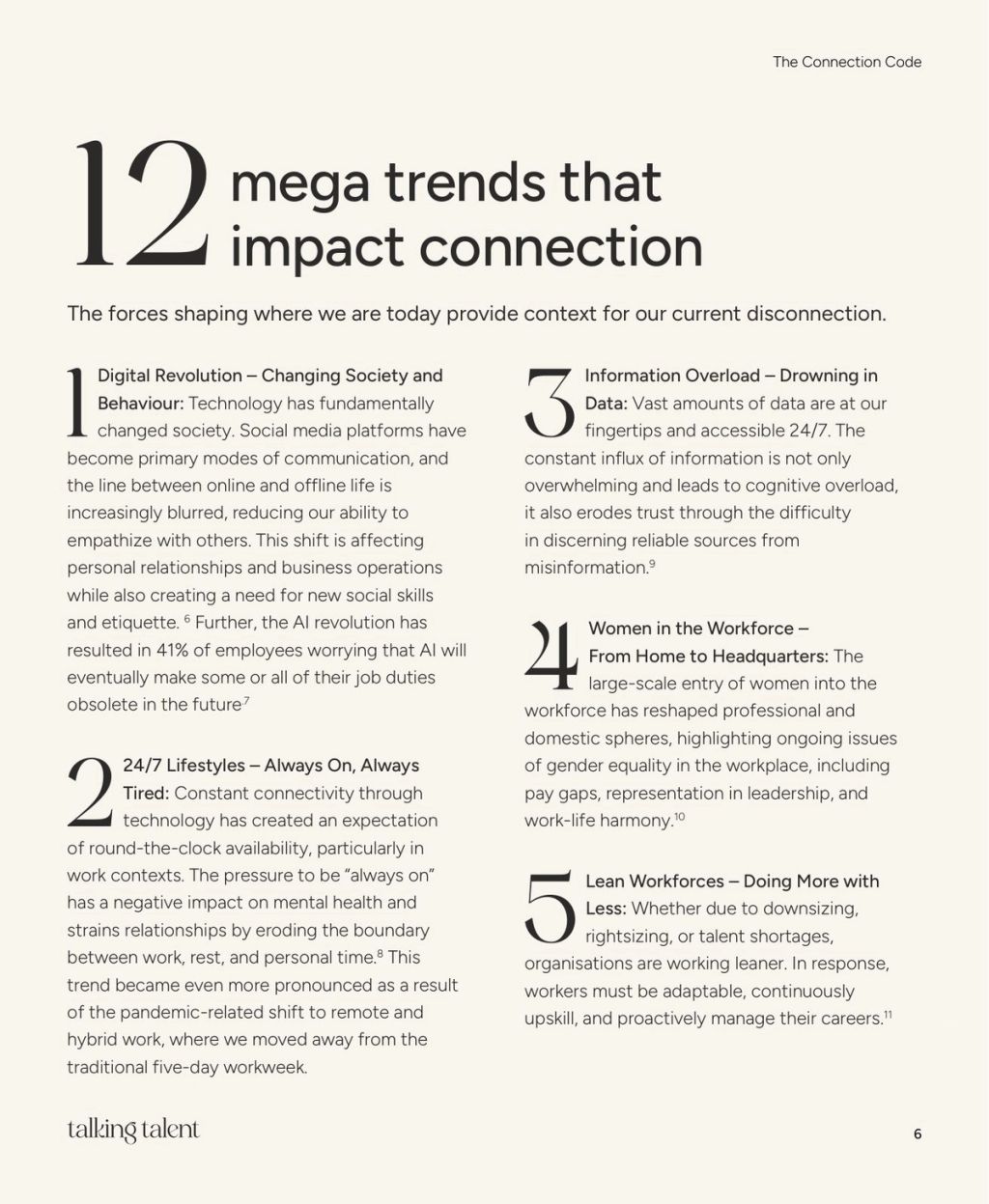
Today’s world is a paradox. We have never had more abundance, yet so many basic human needs feel out of reach. We are hyper-connected through technology, yet more isolated emotionally. We have flexible “work from anywhere” policies, but our downtime has been compromised.
The result is a workforce more disconnected than ever, and for companies, that is a productivity and talent crisis. What if the fix isn’t something brand new, but something already hard-wired into each of us?
Inside the paper
- The twelve forces that pulled us apart, from the digital revolution to the always-on day
- Why previous inclusion efforts fell short, and what to do differently
- The Connected Journey: four pillars for rebuilding connection at work, with practical steps for each
The cost of disconnection
- lost to disengagement: what low engagement costs the global economy
- $8.9trn
- Source: Cited in The Connection Code
- of UK employees feel engaged at work (23% globally, 33% in the US)
- 10%
- Source: Cited in The Connection Code
- more likely to be innovative and agile when organisations prioritise connection
- 6×
- Source: Cited in The Connection Code


















Why connection works
Connection is hard-wired into humans
Neuroscientist Dr Matthew Lieberman argues that our need for social connection is as fundamental as food and shelter. Throughout history, survival depended on group cohesion; isolation simply wasn’t an option.
Yet as organisations have grown, so have the barriers that divide us: silos, competition, disengagement. The strongest companies don’t just recognise the need for connection; they build environments where people align around a shared purpose while treating differences as a strength.
This isn’t about making everyone the same. Group belief is not group think. When people unite around a mission, they are more willing to combine strengths, experiment and adapt, which is precisely where breakthroughs come from.

The Connected Journey
Four pillars of a connected workplace
You can’t just tell employees to “connect”. You have to create the conditions where new habits form and stick. Behaviour change science gives us a framework to do it.
01
Connected Culture
If you want people to flourish, the culture around them has to support them. Even the most resilient employees struggle where honest conversation is stifled.
- Empower change agents at every level
- Run a connection audit to find the real barriers
- Recognise the outsized impact of leaders
- Measure belonging, then iterate
02
Connected Leaders
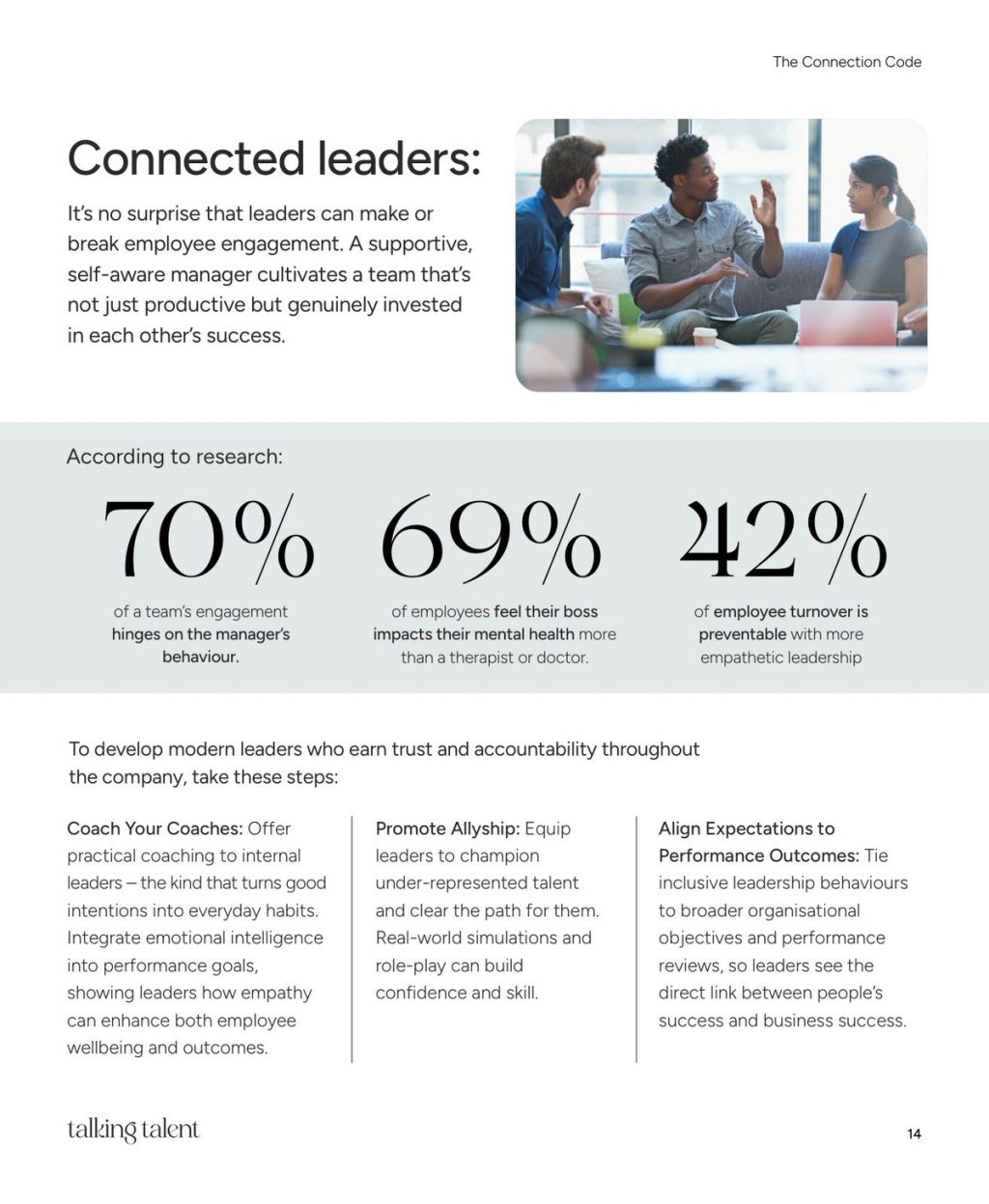
Leaders make or break engagement: 70% of a team’s engagement hinges on the manager, and 69% of employees say their boss affects their mental health more than their doctor.
- Coach your coaches: turn intent into habit
- Promote allyship through real-world practice
- Tie inclusive behaviours to performance
03
Connected Talent
The best organisations grow talent from everywhere. Outdated patterns too often push gifted people to the margins, sometimes without anyone noticing.
- Celebrate the individual, beyond any “checkbox” identity
- Build skills, networks and career navigation
- Embrace genuine mentorship across groups
- Track outcomes and refine
04
Connected Life
The line between life and work has never been more blurred: 73% of US adults report some form of caregiving. Support people in the middle of it, not after the fact.
- Personalised support at moments of transition
- Visible role models for work-life reality
- Resilience tools that reduce burnout
- Continuous dialogue as circumstances change
Who it’s for
Is this paper for you?
Read it if
It’s for leaders who are asking
- Why does engagement keep sliding despite everything we’ve invested?
- Why did our inclusion programmes stall after the training ended?
- Why do we keep losing the talent we worked hardest to find?
- What actually changes behaviour, rather than just awareness?
Skip it if
It may be less relevant if
- You’re looking for a compliance checklist or a policy template
- You want a one-off workshop rather than sustained change
- You need HR process design rather than a cultural diagnosis
Connection Audit
Where are your own gaps?
The Connection Audit scores your organisation across the same four pillars in three minutes, with a visual snapshot of where to focus.
Take the Connection AuditSample snapshot
Overall 6.9/10
Connected Life
9.1/10
strongConnected Talent
7.4/10
moderateConnected Leaders
6.2/10
moderateConnected Culture
4.8/10
low
Questions about The Connection Code
What does The Connection Code cover?
Why workplace connection has eroded (twelve mega trends, from the digital revolution to changing community ties) and the Connected Journey: a four-pillar framework covering culture, leaders, talent and life.
Why have previous inclusion efforts fallen short?
Three reasons recur. Interventions focused on changing individuals rather than the wider behavioural and cultural patterns. Training was treated as a one-time fix rather than sustained practice. And senior leaders treated inclusion as an HR initiative rather than a core business priority.
Is this just another DE&I paper?
No. The argument is that the most effective approach has always been building genuine connection to purpose, work and one another: our shared need for belonging, rather than emphasising differences between groups in a way that creates otherness.
What role does coaching play?
Behaviour change needs consistent practice and reinforcement over time. Coaching is what turns good intentions into everyday habits, for leaders, for under-represented talent and for people navigating the transitions where work and life collide.
How do we know where our own gaps are?
Start with data. The Connection Audit is a free, three-minute diagnostic that scores your organisation across the same four pillars and returns a visual snapshot.
Whitepaper
The Connection Code
What happens when people feel genuinely connected to their work, their leaders, and each other.
Get the whitepaperRelated reading
Why Organisational Change is Personal.
Explore the human side of organisational change and how it impacts personal experiences and perceptions during transitions.
Getting to Better: Five Strategies For Encouraging Belonging in the Workplace
Explore the importance of belonging in the workplace and how it enhances employee engagement and productivity.
The ROI of Human Connection: Why Business Leaders Can’t Afford to Ignore It
Explore why human connection is a vital business investment. Learn how social bonds drive innovation, staff retention, and higher profitability.