

Research report · with Minnesota State University
Climbing Walls, Not Ladders
Why tomorrow’s leaders need a stronger handhold today
What’s inside
The traditional career ladder is an outdated metaphor for professional growth.
Today’s leaders climb walls, with sideways moves, leaps of faith and uncertain holds. New research from Talking Talent and psychologists at the OERG department at Minnesota State University reveals why women, caregivers and early-career professionals face the steepest climb, and how belonging, mentorship and access to leaders create the secure holds that keep tomorrow’s leaders moving upward.
Inside the paper
- Three pivotal career inflections: future leaders, caregiving and the cost of exclusion
- What the survey found about ambition, obstacles and intent to leave, by age, gender and caregiving status
- Three critical imperatives, with practical recommendations for each
What the research found
- Caregivers are twice as likely to aspire to senior roles as their peers
- 2×
- Source: Climbing Walls, Not Ladders (Talking Talent and Minnesota State University, 2026)
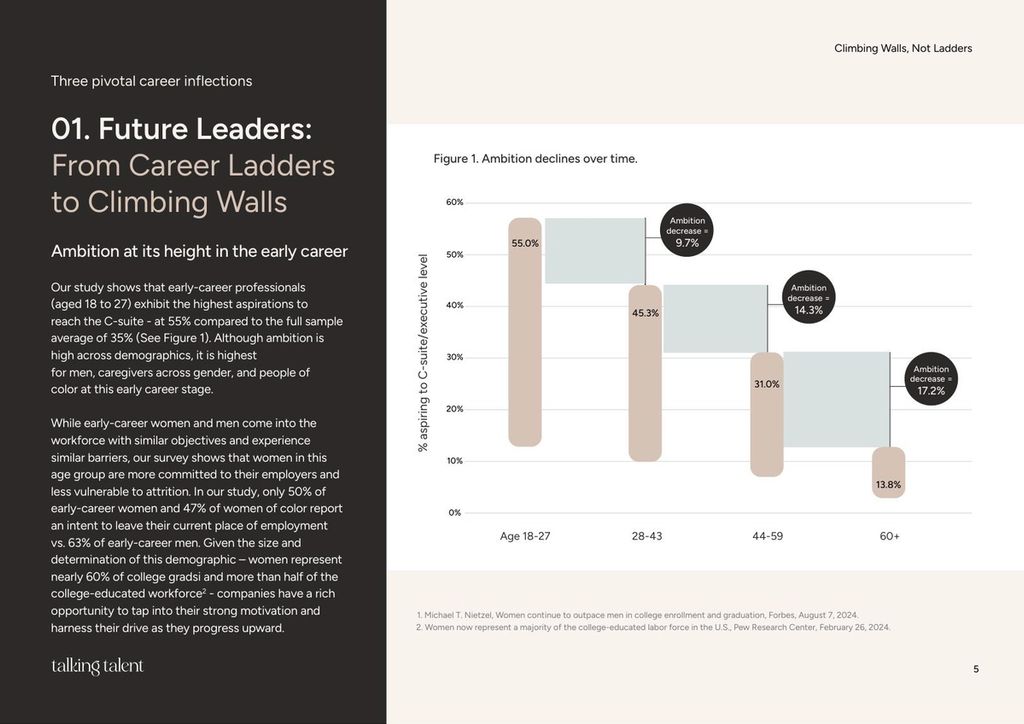
- of early-career professionals are already aiming for the C-suite
- 55%
- Source: Climbing Walls, Not Ladders (Talking Talent and Minnesota State University, 2026)
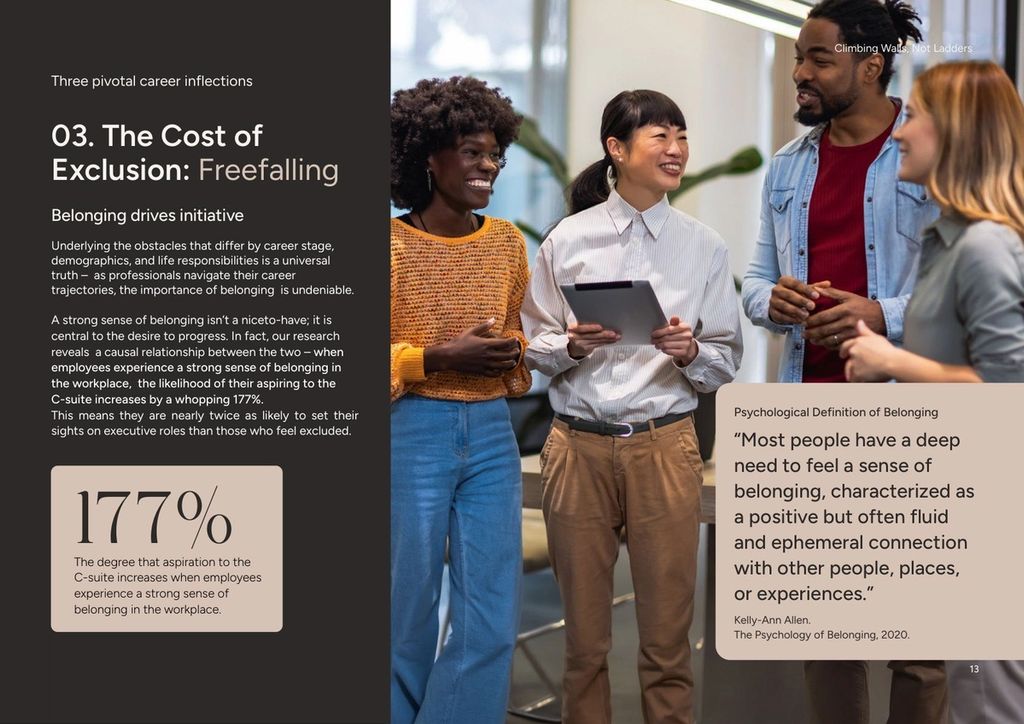
- rise in C-suite aspiration when people feel a strong sense of belonging
- 177%
- Source: Climbing Walls, Not Ladders (Talking Talent and Minnesota State University, 2026)


















The research
The upward career path now looks more like a climbing wall
Unlike a ladder, which relies mainly on upward movement, a climbing wall takes a mix of vertical, sideways and sometimes even downward moves to find the best path forward. The climb to leadership means navigating fast change, barriers to progression and life’s evolving responsibilities, with uncertain holds and leaps of faith along the way.
Our research with psychologists at Minnesota State University shows that while there are challenges for all, the climb can be more precarious for some: especially women, caregivers and early-career professionals. These groups may be an organisation’s most promising talent, yet they face decisive moments when careers can be derailed and advancement blocked.

Three pivotal career inflections
Where the climb gets harder
01
Future leaders: from career ladders to climbing walls
Ambition is at its height early on: 55% of 18 to 27 year olds aspire to the C-suite, against 35% across the sample. Organisations that harness that drive early keep it.
02
Caregiving: uneven holds and heavy loads
Caregivers are twice as likely to aim for senior roles, yet 61% report obstacles to progression (73% with several caring responsibilities) and 69% feel overlooked at work.
03
The cost of exclusion: freefalling
Belonging isn’t a nice-to-have. When people feel a strong sense of belonging, their aspiration to the C-suite rises by 177%. Without it, talent loses its grip.
Three critical imperatives
How organisations build stronger handholds
The paper closes with practical recommendations, so your most valuable talent doesn’t fall off the wall before they gain a foothold.
01
Future leaders: instil career holds
- Broker introductions to leaders and sponsors
- Target upskilling and coaching early
- Make managers invested in direct reports’ careers
02
Caregivers: fuel the climb
- Speak openly about caregiving
- Provide caregiver-specific career coaching
- Make caregiving benefits available to all
03
Belonging: a wall built for all
- Empower allies to take tangible action
- Connect people across difference
- Personalise career mobility programmes
Who it’s for
Is this paper for you?
Read it if
Senior HR and talent leaders rethinking what progression looks like
Organisations that want more resilient, inclusive and future-ready leadership pipelines, especially where talented people are navigating transitions, caregiving, confidence barriers or unclear routes to advancement.
Skip it if
You want a simple promotion checklist
This isn’t a conventional career-ladder report. It explores the messier reality of progression today: nonlinear paths, pivotal moments and the conditions that help talent keep climbing.
Questions about Climbing Walls, Not Ladders
What is Climbing Walls, Not Ladders about?
It’s a research paper from Talking Talent exploring why career progression no longer follows a simple, linear path: how professionals navigate a “climbing wall” of upward, sideways and sometimes downward moves, and the role of belonging, ambition, confidence and organisational support in helping future leaders keep moving.
Why is the traditional career ladder outdated?
The ladder assumes progression is vertical, predictable and a clear sequence of promotions. Modern careers are shaped by organisational change, caregiving, career breaks, confidence barriers, hybrid work and nonlinear development. A climbing wall reflects the different routes people take to leadership.
How can organisations strengthen their leadership pipeline?
By creating clearer, more inclusive routes to progression: access to coaching, sponsorship and manager support, flexible career paths, inclusive leadership development and a stronger sense of belonging.
How does coaching support career progression?
Coaching helps people navigate pivotal moments with more confidence, clarity and resilience: exploring ambition, managing transitions, building leadership capability and staying engaged through uncertainty. For organisations it strengthens retention, progression and leadership readiness.
Research report
Climbing Walls, Not Ladders
Why tomorrow’s leaders need a stronger handhold today
Get the research reportRelated reading

The Career Paradox for UK Women
In our 2014 survey of 1,000 UK professional women, 80% said their employer supported women, yet 36% had faced prejudice at work because of their gender. Here is what we found, sector by sector, and what it asks of employers.
Coaching in the Workplace: Choosing the Format That Changes Behaviour
The question is not which coaching format is best. It is what behaviour you are trying to change, and which format can carry that weight.
Leading Has Changed. Has Leadership Development?
Explore essential leadership skills that can enhance your effectiveness and influence within any organisation.